The short answer: Reading the Quran means being able to sound out the Arabic words. Reciting it properly means pronouncing every letter from its correct place, with the right length, weight and pauses, the way the Quran was taught. Many people read fluently for years without ever being corrected on the second part, and they usually have no idea.
That’s the whole distinction. The rest of this article is about why it matters, how to spot where you are, and what to do about it without feeling like you’ve wasted the last ten years.
Quick summary, for people in a hurry
- Reading is decoding the letters and words. Reciting is doing it accurately, with Tajweed.
- You can read quickly and still make small, repeated mistakes you can’t hear yourself.
- Scholars divide recitation mistakes into major ones (which change letters, vowels or meaning) and minor ones (which affect quality and beauty).
- The Quran tells us to recite in a measured way (Surah Al-Muzzammil, 73:4). Ali ibn Abi Talib explained that as pronouncing each letter properly and knowing where to stop.
- Struggling is not failing. A well-known hadith promises a double reward to the person who finds it hard.
- The fix is rarely more reading. It’s being listened to by someone qualified.
So What Is “Reading” the Quran, Exactly?
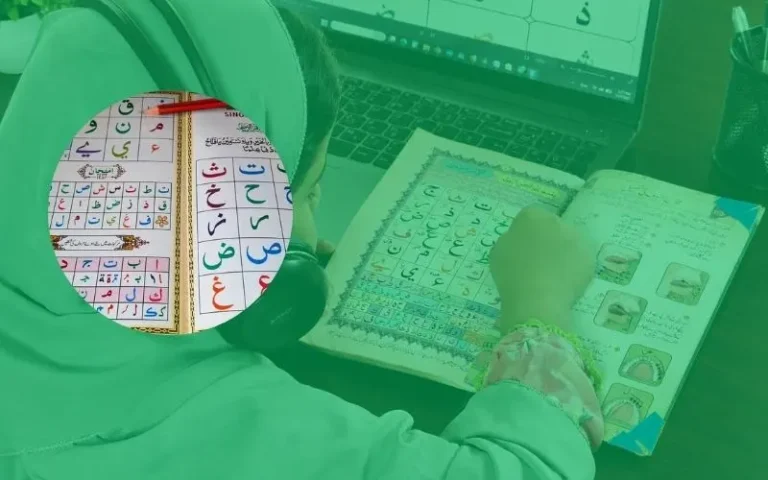
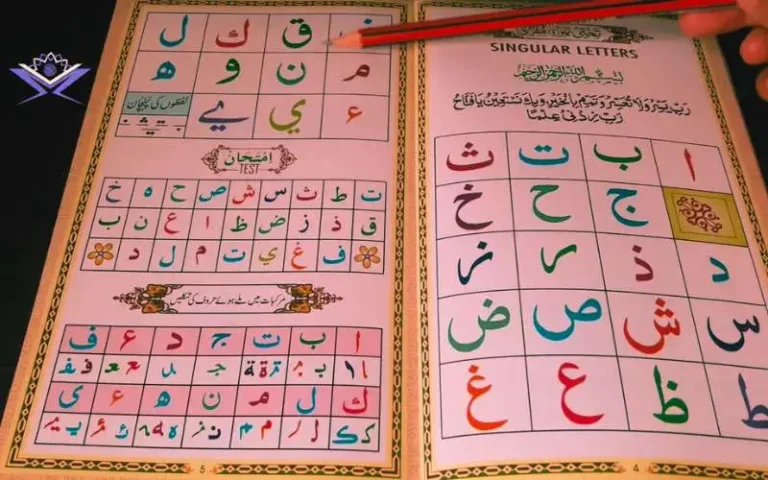
Reading is the skill most of us picked up first. You look at the Arabic, recognise the letters, join them into words, and say them aloud. If you went through a Noorani Qaida or a madrasah as a child, this is probably what you’re doing now, and you may be quite quick at it.
It’s a real achievement. Plenty of people can’t do it at all.
But reading, on its own, is decoding. You’re turning symbols into sounds, and the sounds come from whatever your mouth already knows how to do. For a UK-born learner, that means your English-speaking mouth is quietly translating Arabic letters into the nearest sounds it has available. Sometimes it gets close. Sometimes it doesn’t.
And What Does “Reciting Properly” Add?
Reciting properly has a name: Tajweed. The word comes from an Arabic root meaning to make something excellent, and technically it means giving every letter its due. That “due” has a few parts:
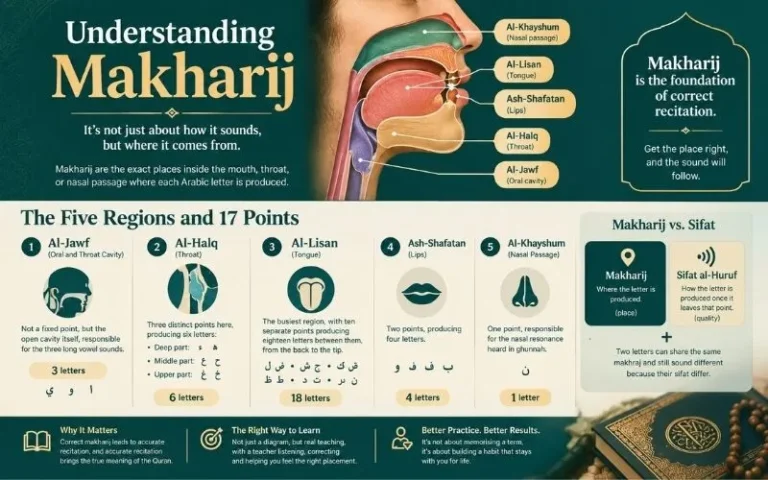
- Where the letter comes from. Each letter has a specific exit point in the throat, tongue, lips or nasal passage. This is what we cover in our guide to Makharij and why where a letter comes from matters.
- How the letter behaves. Some letters are heavy, some light, some released with a slight bounce, some held back. These are the letter qualities, called Sifat.
- How letters affect each other. A noon with no vowel sounds different depending on what follows it. Those are the Noon Sakinah and Meem Sakinah rules.
- How long to hold a sound. Vowel lengthening, called Madd, has specific counts.
- Where to pause and where not to. Stopping in the wrong place can break or change the meaning of a verse.
The Quran describes this as measured recitation. Surah Al-Muzzammil (73:4) says to recite the Quran in a slow, measured, deliberate way, using the word tartil. Ali ibn Abi Talib is reported to have explained it as pronouncing the letters correctly and knowing where to stop. In other words, this isn’t a modern add-on for perfectionists. It’s built into the instruction.
The Same Verse, Read Two Ways
Here’s where it stops being abstract.
Take the difference between the letters ق (qaf) and ك (kaf). One comes from the very back of the tongue, the other from a little further forward. Many English speakers say both the same way, close to a “k”. Now look at the command “Say” in the Quran: Qul. Read it with a kaf and you’ve said Kul, which means “eat”. That’s the example scholars often give for a mistake that changes the word entirely.
Or take a short vowel. An’amta (“You have favoured”) and an’amtu (“I have favoured”) differ by a single vowel on the last letter. In Surah Al-Fatiha, that one vowel is the difference between “those You have favoured” and something else entirely.
Most mistakes aren’t this dramatic. That’s the point. They’re small, they happen without you noticing, and they sit quietly inside otherwise fluent reading.
Major Mistakes and Minor Ones: How Scholars Describe the Gap
Classical Tajweed scholarship divides recitation errors into two groups, called lahn.
Lahn jali (the obvious mistakes). These change a letter, a vowel or a word in a way that alters the meaning or breaks the Arabic. Swapping ق for ك, reading a short vowel as a different vowel, stretching a sound that shouldn’t be stretched. Scholars treat these as serious, and they’re the ones a trained listener catches straight away.
Lahn khafi (the hidden mistakes). These don’t change the word or its meaning, but they take away from the correctness and beauty of the recitation. Not holding a Madd for its full length, leaving out the nasal sound called ghunnah where it belongs, or pronouncing a letter thin when it should be full. Because they’re subtle, the reciter often can’t hear them, and neither can most listeners without training.
Scholars differ on the exact rulings, especially on how strictly the finer rules apply to every individual and what that means for prayer. If you want a specific answer about your own situation, ask a qualified scholar. What nearly everyone agrees on is the direction: avoid the mistakes that change the Quran, and work towards the rest.
“But My Reading Sounds Fine to Me”
It probably does. That’s the problem.
Your ear was trained on the sounds you’ve heard most. If you’ve been pronouncing a letter a certain way for twenty years, it will sound correct to you, because it matches what’s in your head. This is true of every language. Ask any English speaker who has tried to roll an Arabic or Spanish “r” and thought they’d done it perfectly.
A few signs that your reading might have gaps:
- Several letters sound almost the same when you say them (س and ص, ت and ط, ذ and ظ, ق and ك).
- You pause where you run out of breath, not where the verse suggests.
- You have never heard the terms Ikhfa, Idgham or Qalqalah, or you’ve heard them but couldn’t explain them.
- A teacher or another reciter once corrected you, and you didn’t fully understand what they were correcting.
- You read quickly, but if someone asks you to slow down and recite in a measured way, it falls apart.
None of this means you’ve done anything wrong. It means you learned the first half and nobody finished the second.
Why You Usually Can’t Fix This on Your Own
This is where a lot of people try the obvious solution: watch videos, use an app, read more. Those help with knowledge. They don’t help much with correction.
The reason is simple. Fixing pronunciation needs feedback, and feedback needs a listener who knows what correct sounds like. An app can tell you the rule. A video can show you the mouth shape. Neither can hear you say a letter and tell you that it’s still sitting a little too far forward.
It’s also why practising alone can backfire. If you repeat a letter wrongly fifty times, you haven’t improved. You’ve practised the mistake fifty times, and made it more automatic.
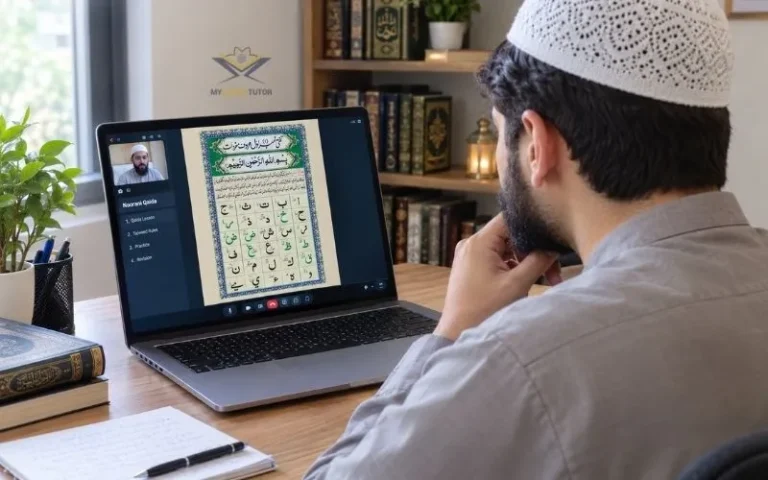
This is the main reason one-to-one teaching matters for recitation specifically. It’s not a sales line. It’s how the skill is built: a teacher listens, catches the thing you can’t hear, and has you try again until you can feel the difference yourself.
Is It Too Late If I’ve Been Reading Wrongly for Years?
No. And there’s something in the hadith tradition that deserves to be said out loud here.
It’s reported from Aisha, in both Bukhari and Muslim, that the Prophet (peace be upon him) said the one who recites the Quran skilfully will be with the noble angels, and the one who recites it while stumbling and finding it difficult will have two rewards.
Two rewards. For the person who finds it hard.
That’s not an excuse to stop improving. It’s a reason to keep going without shame. If you’re an adult who never learned properly, or a parent worried you’ve been teaching your child with gaps of your own, you’re in the group that the hadith is speaking to.
If you’re starting from the alphabet, our piece on Noorani Qaida for adults explains how that works. If you already read, the next step is a course built around correction, not repetition.
How Proper Recitation Is Actually Taught
A good Tajweed teacher usually works in this order:
- Listen first. In the first lesson, you read something familiar. The teacher is not teaching yet. They’re mapping where your reading is solid and where it isn’t.
- Fix articulation points before anything else. Everything else sits on top of this, which is why Makharij comes first.
- Add letter qualities and the main rules gradually. Not all at once, and not as a list to memorise.
- Apply everything to real verses. Rules on a whiteboard don’t stay. Rules used on Surah Al-Fatiha or Surah Al-Ikhlas do.
- Slow the pace down. Most students arrive reading too fast. Measured recitation is the aim, and it takes practice to reach.
That’s the structure behind our Quran reading course with Tajweed, and it’s the same for children and adults. Children usually start the course after Noorani Qaida. Adults often start with an assessment to find the right level, because their starting points vary so much.
Reading vs Reciting at a Glance
What to Do Next
If you’re not sure where you stand, don’t guess. Book one lesson and read something you already know. A qualified teacher will tell you plainly what’s solid, what needs work, and how long it’s likely to take. You can browse the rest of what we teach through our online Quran classes for adults and children and meet our online Quran teachers, or look at the fees first.
Whatever you decide, the starting point is the same. Reading got you here. Now it’s about listening.
Not Sure Where Your Recitation Stands?
Book a free trial lesson and read with a teacher who listens. No card required.
Book Your Free Trial Lesson →Frequently Asked Questions
What is the difference between reading the Quran and reciting it?
Reading means decoding the Arabic letters and words aloud. Reciting properly means doing that with Tajweed: pronouncing each letter from its correct articulation point, with the right qualities, lengths and pauses. A person can read fluently without reciting accurately.
Is Tajweed compulsory?
Scholars agree that mistakes which change letters, vowels or meaning must be avoided. Views differ on how strictly the finer rules apply to every individual, and on how that affects prayer. For a ruling on your own situation, ask a qualified scholar.
What are lahn jali and lahn khafi?
Lahn jali are major mistakes that change a letter, vowel or word, such as reading ق as ك. Lahn khafi are minor mistakes that don’t change the meaning but affect quality, such as shortening a Madd or missing a ghunnah.
Can I learn Tajweed if I’ve been reading incorrectly for years?
Yes. Habits can be corrected at any age, though they take consistent practice with a teacher who listens. There’s also a well-known hadith, narrated by Aisha, promising a double reward to the person who recites with difficulty.
Can I learn Tajweed from apps or videos?
They’re useful for learning the rules, but they can’t hear you or correct your pronunciation. Most people need a live teacher to catch the mistakes they can’t hear themselves.
How long does it take to learn to recite properly?
It depends on your starting point, how often you have lessons and how much you practise between them. Many students reach comfortable, accurate recitation within several months of regular one-to-one lessons, though complete beginners and adults starting from scratch may take longer.