No, it is not too late. That’s the short answer, and if it’s the only thing you needed, you can stop reading here and go and book a lesson.
But if you’re sitting there at 28, or 41, or 63, feeling a bit silly about not being able to read the Quran, the short answer probably isn’t enough. You want to know whether you’ll be the oldest beginner in the room. Whether it’ll take years. Whether you’ll be judged. Whether your brain still does this sort of thing at your age.
Those are fair questions, so let’s go through them properly.
So, Is It Really Not Too Late?
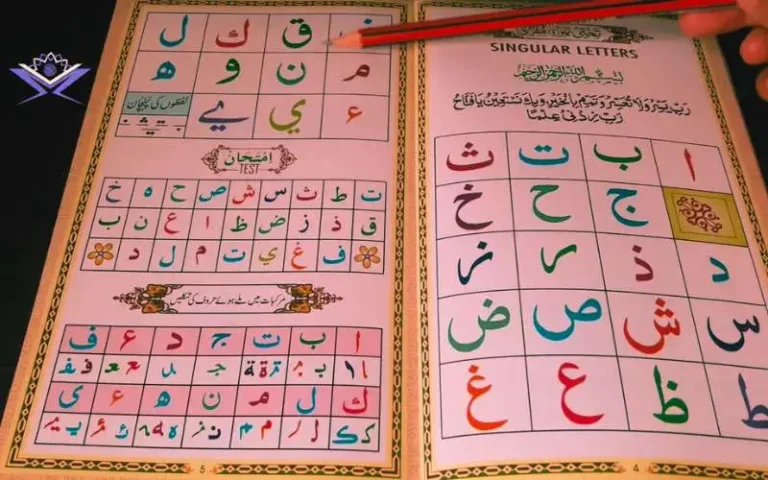
There is no age limit on learning to read Arabic letters. None. Noorani Qaida is a beginner’s primer. It starts with single letters, moves to joined letters, then short vowels, then longer sounds, and builds up slowly from there. It was designed for people who cannot read Arabic at all. Starting from zero isn’t a problem with the method. It’s the whole point of it.
And adults are not "late" students in the way people imagine. A few things work in your favour that a seven-year-old doesn’t have:
- You already know how to learn. You’ve learned a job, a language, a route to work, maybe a hobby.
- You can sit still for a 30-minute lesson without a snack bribe.
- You know exactly why you want this, which beats any reward chart.
- You can ask questions out loud and understand the answers.
Where adults struggle is rarely ability. It’s confidence. And that’s something we can actually do something about.
The Real Reasons Adults Put This Off
If you ask adult beginners why they waited so long, the answer is almost never "I didn’t have time." It’s usually one of these.
Embarrassment. You’re a grown adult, maybe a parent, maybe a manager, maybe the person everyone else comes to for answers. Admitting you can’t read the Alif-Ba-Ta feels exposed. A lot of people also assume everyone else in the community learned this as a child and that they’re the only one who didn’t. They’re not. Plenty of British Muslims never had a proper chance to learn growing up, whether that was because of where they lived, the mosque classes available, or simply how things went.
Being a revert. If you came to Islam as an adult, you were never "supposed" to have learned this as a child. Nobody expects you to know it already. Starting Noorani Qaida as a revert isn’t catching up on something you missed. It’s simply the right first step.
The old lesson that went wrong. Some adults did start as children and had a bad experience: a strict teacher, a crowded class, a rushed syllabus. They learned to read the words with no real understanding of the sounds, and eventually gave up. Starting again properly, with a patient teacher, often feels completely different the second time.
Worrying about time. Work, children, commuting, caring for family. A weekly class at a fixed time in a building across town was never going to fit. That’s a scheduling problem, and it’s much easier to solve online than most people think.
None of these are reasons you can’t learn. They’re reasons it feels harder to begin. Once you’ve had the first lesson, most of that weight tends to drop away.
How Long Does It Take an Adult to Learn Noorani Qaida?
There’s no honest single number, and anyone who promises one is guessing.
What actually affects the pace:
- How often you have lessons. Two a week moves faster than one. One a week with ten minutes of daily practice beats one a week with nothing in between.
- Whether you’ve seen Arabic before. If you grew up around the Quran and can half-recognise the letters, you’ll move faster than someone who has never seen them.
- How much you practise between lessons. This matters more than almost anything else.
- How you feel about mistakes. Adults who relax into getting things wrong progress faster than those who freeze up.
As a rough guide, many adults working steadily with a teacher get through the core of Noorani Qaida in a matter of months, not years. Some are quicker. Some take longer, and that’s perfectly fine. A good teacher won’t push you onto the next lesson just to keep to a timetable. If a rule hasn’t settled, you stay on it until it has.
Once the foundations are solid, the natural next step is the Quran reading course with Tajweed, where you start reading real verses and applying the rules properly.
What a Normal Week Looks Like for an Adult Learner
It’s a lot less dramatic than people imagine.
A typical week might be one or two lessons of around 30 minutes, held at a time that suits you: early morning before work, a lunch break, after the children are in bed. Between lessons, you practise for ten to fifteen minutes a day. That’s it. You don’t need to study for hours.
Short and regular beats long and rare. Ten minutes every day does far more than a Sunday cram session, because the point is to train your mouth and your ear, and that happens through repetition, not effort.
If you can’t manage ten minutes on a particular day, don’t write the whole week off. Just pick it up the next day. Adults tend to be harder on themselves than any teacher would ever be.
Why One-to-One Suits Adults Better Than a Class
A group class is built around the pace of the group. That works for some people. For adult beginners it often doesn’t, for a few reasons. If you’re searching for online Quran classes for adults, this is the first thing worth checking: whether the lessons are truly one-to-one or just a shared call with a bigger name.
You’re not on display. In a one-to-one lesson, nobody else hears you stumble over a letter. That alone removes a surprising amount of pressure.
The lesson fits you, not the average. If you keep mixing up two letters, your teacher spends time there. If you pick up the vowels quickly, you move on. Nobody’s waiting for you, and you’re not waiting for anyone else.
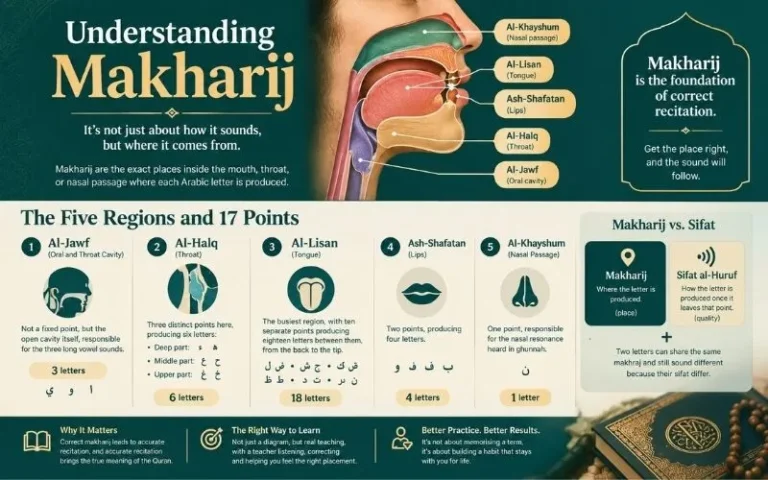
Correction is immediate and private. This matters more than people realise. Many Arabic letters have no real equivalent in English, and your own ear can’t tell you when you’ve got one wrong. We go into this in more detail in our piece on Makharij and why where a letter comes from matters, but the short version is that you need someone listening in real time. A video can’t do that.
If you’d feel more comfortable learning with a woman, you can learn with a female Quran teacher. Many of our adult students do, and there’s no need to explain why.
A Few Mistakes Adult Beginners Make (and How to Avoid Them)
These come up again and again.
Rushing to read "real" Quran too soon. It’s tempting. You want to get to the verses. But skipping the foundations just means you’ll go back and fix them later, which is slower and more frustrating.
Learning the letters only by their English-sounding names. Arabic letters don’t behave like English ones. Rely on your teacher’s voice and the actual sounds, not on a transliteration cheat sheet.
Practising wrongly in private. If you repeat a letter incorrectly fifty times between lessons, you’ve just practised the mistake fifty times. This is why even a short check-in with a teacher beats long solo sessions.
Comparing yourself to children. You’ll see seven-year-olds who read fast. They also don’t have a job, a mortgage and a to-do list. Compare yourself to where you were last month.
Quitting after a bad week. Everyone has one. Plateaus are normal, and they usually come right before things click.
What If You’ve Tried Before and Stopped?
Then you’re in good company, and you haven’t lost as much as you think. Old learning doesn’t vanish. It’s often still there underneath, which is why returning students tend to move quicker the second time round. A short assessment in your first lesson will show where you actually are, rather than where you assume you are.
If you’re also wondering whether the name matters, our short explainer on Noorani Qaida vs Qaida Nooraniah clears that up.
Where to Start
Start with one lesson. Not a commitment, not a course, just one conversation with a teacher who will listen to where you are and tell you plainly what’s realistic. Our Noorani Qaida course is built for exactly this: adults and reverts starting from nothing, at a pace that suits your week. You can check the fees first if you’d like to know the cost before you book anything.
You’ve probably been thinking about this for longer than you’d like to admit. The only thing that actually makes it later is waiting another year.
Ready to Start Learning Noorani Qaida?
Book a free trial lesson and find out exactly where you are. No card required.
Book Your Free Trial Lesson →Frequently Asked Questions
Is it too late for an adult to learn Noorani Qaida?
No. Noorani Qaida is a beginner’s primer designed for people who can’t read Arabic at all, and adults of any age can learn it. Many adult students start in their thirties, forties and beyond.
How long does it take an adult to finish Noorani Qaida?
It depends on how often you have lessons, whether you’ve seen Arabic before, and how much you practise between sessions. Many adults working steadily with a teacher complete the core in a matter of months. A good teacher moves at your pace rather than a fixed timetable.
I’m a revert. Should I start with Noorani Qaida?
Yes. It’s the standard first step for anyone learning to read the Quran from scratch, whether they came to Islam as an adult or simply never had the chance to learn as a child. You aren’t behind. You’re at the beginning, which is exactly where Noorani Qaida starts.
Can I learn Noorani Qaida online as an adult?
Yes. One-to-one online lessons let you learn privately, at times that fit around work and family, and receive live correction from a teacher. Many adults prefer this to a group class because there’s no one else listening.
How much should I practise between lessons?
Ten to fifteen minutes a day is enough for most adults. Short, regular practice works better than one long session a week.
Can I learn with a female teacher?
Yes. We have female teachers available for women and girls of all ages, including adult beginners.