Most people learning to read the Quran try to copy a sound. They hear a letter, they hear how it’s supposed to sound, and they try to reproduce that sound as closely as they can by ear. It’s a completely understandable instinct, and it’s also exactly why so many people plateau at roughly the same level for years without realising why.
Makharij takes a different approach entirely, and it’s worth understanding properly rather than treating it as another technical word to memorise.
What Makharij Actually Means
Makharij is the plural of makhraj, an Arabic word that simply means “an exit point” — or more precisely, the exact physical place inside the mouth, throat, or nasal passage where a letter’s sound is produced. Not what it sounds like from the outside. Where it physically comes from on the inside.
This is a genuinely different question to “how does this letter sound,” and the difference matters more than it first appears. Two letters can sound superficially similar to an untrained ear while coming from two completely different places in the mouth or throat. Once you know where each one is actually meant to come from, you stop confusing them by accident, which is exactly the habit our Noorani Qaida course starts building from the very first lesson, long before Makharij is even named as a topic.
Why Sound Alone Is a Trap
Imitating sound works reasonably well for letters that already exist in your own language. It falls apart for the ones that don’t, and Arabic has several letters with no real equivalent in English at all. If you’re only listening and trying to copy what you hear, your mouth defaults to the closest sound it already knows how to make, which is very often the wrong one.
This is exactly how mix-ups like س and ص, or ت and ط, or ذ and ظ, end up becoming permanent habits. From the outside, under casual listening, they can sound almost interchangeable. Once you learn where each one is actually produced, the confusion mostly disappears — and these same mix-ups are the ones we see most often in the most common Noorani Qaida mistakes parents run into at home.
The Five Regions Letters Come From
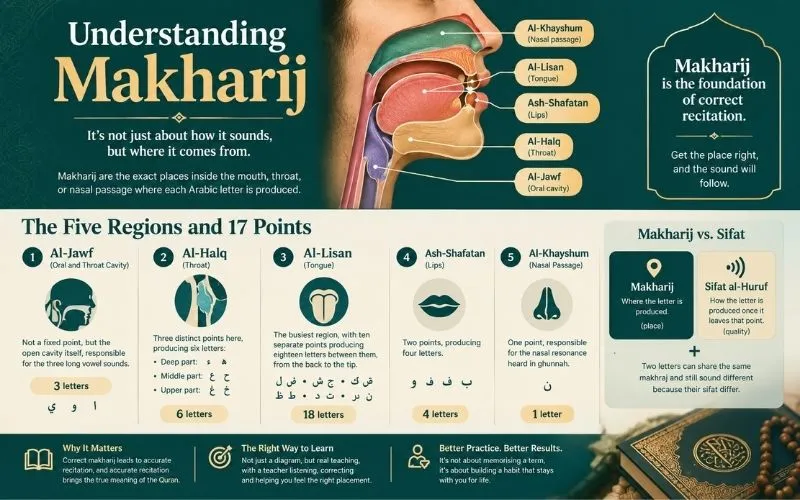
Classical Tajweed scholarship, most notably the work of Ibn Al-Jazari, organises the articulation points into five main regions, with seventeen specific points nested inside them.
- Al-Jawf (the oral and throat cavity) — not a fixed point at all, but the open cavity itself, responsible for the three long vowel sounds.
- Al-Halq (the throat) — three distinct points here, producing six letters: hamzah and ha from the deepest part of the throat, ‘ayn and ha from the middle, and ghayn and kha from the upper part closest to the mouth.
- Al-Lisan (the tongue) — by far the busiest region, with ten separate points producing eighteen letters between them, from the very back of the tongue against the soft palate, all the way to the tip against the teeth.
- Ash-Shafatan (the two lips) — two points, producing four letters.
- Al-Khayshum (the nasal passage) — one point, responsible for the nasal resonance heard in ghunnah.
That’s the actual structure. Not a vague idea of “throat letters” and “mouth letters,” but a specific, mapped-out system where every single letter has one precise home.
Makharij Isn’t the Same as Sifat
This distinction gets blurred constantly, and it’s worth being precise about it. Makharij tells you where a letter is produced. Sifat al-Huruf tells you the qualities of how it’s produced once it leaves that point — whether it’s whispered or voiced, light or heavy, held or released immediately.
Two letters can share the exact same makhraj and still sound completely different because their sifat differ. Getting the makhraj right is the starting point. It’s not the entire picture, but skipping it means nothing built afterwards sits on solid ground — which is exactly why our Quran Reading course with Tajweed only introduces the full Sifat rules once a student’s Makharij is already secure.
Why This Actually Matters for Reading the Quran
This isn’t an abstract linguistics exercise. Two words that differ by a single letter, produced from two different articulation points, can carry entirely different meanings. Reading fluently and reading accurately are not automatically the same skill, and Makharij is the thing that closes that gap.
A student who’s only ever imitated sound can often read at a reasonable pace and still be quietly mispronouncing several letters throughout, without anyone noticing unless a trained teacher is actually listening for it specifically. It’s rarely dramatic. It’s usually small, consistent, and completely invisible to an untrained ear, including the reader’s own.
How This Is Actually Taught Properly
A real teacher doesn’t hand over a diagram and expect it to be memorised in the abstract. It’s built letter by letter, with the teacher listening in real time, correcting the exact placement, and giving the student something to feel physically, not just something to remember as a fact. This is one of the areas where self-study genuinely struggles, since a book can describe where a sound comes from, but it can’t listen to you and tell you whether you’ve actually gotten there.
Want a Real Teacher Listening to Your Makharij, Live?
Book a free trial lesson and find out exactly where your own articulation needs correcting — no card required.
Book Your Free Trial Lesson →Frequently Asked Questions
What does Makharij mean in simple terms?
Makharij means the specific physical points in the mouth, throat, or nose where each Arabic letter is produced. It’s about where a sound comes from, not just what it sounds like.
How many Makharij points are there?
The most widely taught count is seventeen detailed articulation points, grouped into five main regions: the oral cavity, the throat, the tongue, the lips, and the nasal passage.
Is Makharij the same as Tajweed?
No. Makharij is one foundational part of Tajweed. Every other Tajweed rule, including Noon Sakinah, Qalqalah, and Madd, is built on top of correct Makharij, but Tajweed as a whole covers more than articulation points alone.
Can I learn Makharij by myself from videos?
You can learn the theory this way, but correcting your own placement is genuinely difficult without someone listening to you directly, since the whole point is catching mistakes your own ear won’t notice.
Why do I keep confusing certain Arabic letters even after practising?
This usually means the letters are being learned by sound alone rather than by their actual articulation point. Once the correct makhraj is learned properly, most of these mix-ups resolve on their own.