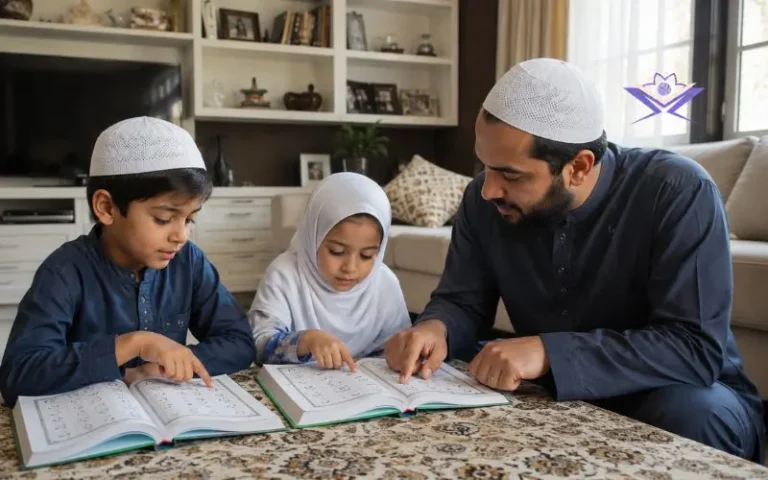


The short answer: With three to five lessons a week and a little practice at home, most children finish the Noorani Qaida in 4 to 12 months and read the whole Quran fluently within 1.5 to 3 years. Most adults get through the Qaida in 2 to 4 months and read comfortably in about a year. But those numbers hide the real answer. How long it takes depends far less on the academy or the teacher than on the student, and on how much the family gets involved.
That’s the answer I give every parent who asks, and nearly every parent asks. Usually in the first call, sometimes before they’ve told me the child’s name. “How long until she finishes?” It’s a fair question. You’re paying for lessons and you want to know where the road ends.
I’ve run an online Quran academy long enough to see hundreds of students go down that road. Some sprint. Some crawl. And the reason is almost never what parents expect.
Quick Summary
- Typical time to finish the Noorani Qaida: 4 to 12 months for children, 2 to 4 months for adults.
- Typical time to read the Quran fluently: 1.5 to 3 years for children, around a year for adults.
- These are ranges, not promises. We’ve seen one child do it in 18 months and others take three years over the Qaida alone, with the same teacher.
- Three things decide the speed: the student’s effort, the parents’ involvement, and the teacher’s guidance. In that order.
- Ten minutes of practice at home each day does more than an extra lesson each week.
- A teacher is a guide. They can show the way, but the student has to walk it.
Two Students, One Teacher
Let me tell you about two kinds of student we’ve had. Same academy. Same teacher. Same lesson length.
The first was a little girl who started the Qaida with us at four years old. By the time she was five and a half, she had read the entire Quran twice, properly, and she knew most of the Tajweed rules by heart. Anything she wanted to memorise, she picked up quickly. Eighteen months, start to finish, and then some.
The second kind of student is one I won’t name, because there have been several. These children sat with that very same teacher for two to three years and still couldn’t read the Qaida properly.
Now, if speed came down to the teacher, both students would have finished at the same time. They didn’t. So something else was going on, and once you see it, you can’t unsee it.
What Was Different
It wasn’t intelligence. The little girl was bright, yes, but so were some of the children who struggled. Here’s what we actually saw.
Her parents asked questions. The others didn’t.
A lot of parents arrange the classes and then step back completely. They never ask the child, “What did you read today?” They never ask the teacher, “How is he getting on?”
What surprises people is that it’s usually the teacher chasing the parent, not the other way round. Our teachers message parents to flag a problem: he’s not practising, she keeps missing the same letter, he seems tired at this time of day. Too often the message gets a thumbs-up and nothing changes.
A child notices this. If nobody at home seems to care what happened in the lesson, the lesson stops mattering to the child too.
She was present in the lesson. Really present.
Showing up isn’t the same as paying attention. We’ve had children log in on time every day and give the lesson maybe a third of their mind. A toy in one hand. A sibling running past. The television on in the same room. Somebody in the family having a loud conversation two feet away.
The teacher then spends half of a thirty-minute lesson just pulling the child’s focus back. That’s fifteen minutes of actual learning. Do that for a year and you’ve had six months of lessons, not twelve.
She practised at home. They didn’t.
This is the big one.
Some parents seem to believe, deep down, that the teacher has a secret. Some special trick that will get the Quran into the child in a few weeks without the child lifting a finger. Back home we’d joke that they think the teacher has a taweez he can dissolve in a glass of water and give the child to drink.
There’s no such thing. The lesson is where the teacher listens to what the child has prepared, corrects it, and shows how to read the next part. The learning itself happens between lessons, when the child sits down and goes over it.
A child who never opens the Qaida between Monday and Wednesday arrives on Wednesday exactly where Monday ended. Often a step behind it.
A Teacher Is a Guide, Not a Shortcut
I say this to parents as plainly as I can, because it saves everyone disappointment later.
Even the most qualified, most experienced teacher in the world is a guide. They hear the lesson. They fix the mistake. They show the student how the next line should sound. Understanding it and practising it is the student’s job, and for a young child, making sure that practice happens is the parents’ job.
Think of a driving instructor. One hour a week in the car with them won’t get you through the test if you never think about driving in between. The instructor matters. They just can’t do the driving for you.
So when someone asks whether a better academy would get their child there sooner, my honest answer is: a good teacher is necessary, but it isn’t enough. The effort has to come from three sides. The student, the parents, and the teacher. Take one away and the timeline stretches.
Realistic Timelines by Age
With all that said, you still deserve numbers. These are the ranges we see in our own students who have three to five lessons a week of about thirty minutes and do some practice at home. They aren’t guarantees, and no honest academy would offer one.
| Age when starting | Noorani Qaida | Reading the Quran fluently (total, from zero) |
|---|---|---|
| 4 to 6 years | 6 to 12 months | 2 to 3 years |
| 7 to 10 years | 4 to 8 months | 1.5 to 2.5 years |
| 11 to 15 years | 3 to 6 months | 1 to 2 years |
| Adults | 2 to 4 months | 9 to 18 months |
A few notes on reading that table.
Young children (4 to 6). They absorb sounds beautifully, often better than anyone, but their attention is short and they can’t practise without an adult sitting with them. That’s why the range is so wide. The girl in my story sat at the fast end of it and then went past it. If you’re wondering whether your child is ready at all, we’ve covered that in our guide on what age a child should start learning the Quran.
Older children (7 to 10). This is the easiest age to teach. They can focus for a full lesson, they can practise alone for ten minutes, and they still pick up pronunciation easily. Most of our steady finishers come from this group.
Teenagers (11 to 15). They learn the rules fast because they can understand explanations. The risk here is schoolwork, exams and phones crowding out practice. A teenager who wants to learn is quick. One who has been told to learn is not.
Adults. Adults usually move through the Qaida faster than any child, because they understand what they’re being asked to do. Pronunciation takes longer to settle, since the mouth has had decades of habit. If that’s you, our guide to the Noorani Qaida for adults explains what the first few months look like.
What “Fluent” Actually Means
Parents and teachers often mean different things by “finished”, so it’s worth being clear.
When we say a student reads fluently, we mean they can open the Quran at any page and read it with correct letters, correct lengths, and the main Tajweed rules applied, without stopping to spell words out. Not at a reciter’s speed. Just smoothly and correctly.
Getting through the pages isn’t the same thing. A child can “finish the Quran” while still guessing at letters, and that has to be undone later, which costs more time than doing it properly once. We explain the gap in our post on the difference between reading and reciting the Quran.
What About Hifz?
Parents of children about to start memorising ask the same question, so here’s the short version.
Hifz depends on the same three things, only more so, because nothing can be memorised in a lesson alone. For a child who already reads fluently and is studying alongside school, three to five years is a common range for the whole Quran. Some do it sooner. Many take longer, and there’s no shame in that.
The single best predictor we’ve seen is reading quality before starting. A child who reads smoothly memorises a page far quicker than one who is still working out the words. That’s why we don’t rush anyone out of reading and into our Quran memorisation course.
What Speeds It Up
None of this is complicated. It’s just rarely done.
- Ten minutes of practice a day. Not an hour on Sunday. Short, regular practice sticks far better than one long session, and research on how memory works has shown the same thing for decades. Today’s lesson, read aloud three times, is enough.
- One question after every lesson. “Show me what you read today.” It takes a minute and it tells your child the lesson matters to you.
- Reply to the teacher. When a teacher flags something, they’re handing you the exact thing that’s slowing your child down. Act on it that week.
- A quiet spot. Door closed, television off, toys out of reach, siblings elsewhere. Thirty minutes of full attention is worth an hour of half attention.
- The same time every day. Children settle faster when the lesson is part of the routine and not a surprise.
- More short lessons, not fewer long ones. Five lessons of thirty minutes usually beat two lessons of an hour, especially under the age of ten.
What Slows It Down
- Missing lessons often, then expecting the same pace.
- Long gaps over holidays with no revision at all.
- Changing teachers or academies every few months, so the child starts again each time.
- Rushing through the Qaida. Mistakes carried forward have to be fixed later, and we’ve listed the usual ones in Noorani Qaida mistakes parents make.
- Comparing your child with a cousin. Every child has their own pace, and pressure makes most of them slower.
A Word to Parents Who Feel Behind
If your child has been in lessons for a year or two and progress is thin, please don’t read this as blame. Most parents were never told any of this. They were sold “your child will finish in six months” and left to wonder what went wrong.
The good news is that this is fixable, and quickly. We’ve watched children who were stuck for a year start moving within a month once a parent began sitting nearby for ten minutes of practice each evening. Nothing else changed. Same child, same teacher, same book.
How We Handle It
Before a student starts with us, we tell the parents what we’ll do and what we’ll need from them. The teacher gives you regular updates on what was covered and what to practise. If we see a child drifting, we say so early.
You can see how the stages fit together on our Quran reading course with Tajweed page, and beginners start with the Noorani Qaida course. If you’d like to know more about how our online Quran classes work, or what they cost, the fee page has everything in one place.
Not Sure Where Your Child Stands?
A teacher will listen to them read and give you an honest picture of how long it might take. No card required.
Book a Free TrialFrequently Asked Questions
How long does it take to learn to read the Quran?
With three to five lessons a week and some practice at home, most children read the Quran fluently within 1.5 to 3 years of starting from zero, and most adults within 9 to 18 months. The exact time depends mainly on the student’s effort and, for children, on how involved the parents are.
How long does it take to finish the Noorani Qaida?
Children usually take 4 to 12 months, with younger children at the longer end. Adults usually take 2 to 4 months. A student who practises daily can finish in roughly half the time of one who only reads during lessons.
Can a child finish the Quran in one year?
Some can, but it’s uncommon and shouldn’t be the target. We had one student who started at four and had read the whole Quran twice by five and a half, with daily practice and very involved parents. Pushing for speed without that support usually leads to weak reading that needs fixing later.
Why is my child taking so long to learn the Quran?
The most common reasons are no practice between lessons, distractions during the lesson, missed classes, and little follow-up at home. It’s rarely about ability. Ask the teacher what’s holding your child back, then work on that one thing for a month.
Does a better teacher make a child learn faster?
A good teacher is essential, because they catch mistakes early and explain things clearly. But a teacher is a guide. If the student doesn’t practise and the parents don’t follow up, even an excellent teacher can’t speed things up much.
How much should my child practise at home?
About ten minutes a day is enough for most children. Have them read that day’s lesson aloud two or three times. Daily practice matters more than the length of each session.
Is it harder for adults to learn to read the Quran?
Adults usually learn the rules faster than children because they understand explanations. Pronunciation can take longer to correct. Most adults who practise regularly read comfortably within about a year.
How long does it take to memorise the Quran?
For a child who already reads fluently and studies alongside school, three to five years is common, though it varies widely. Strong reading before starting Hifz makes the biggest difference to the pace.