
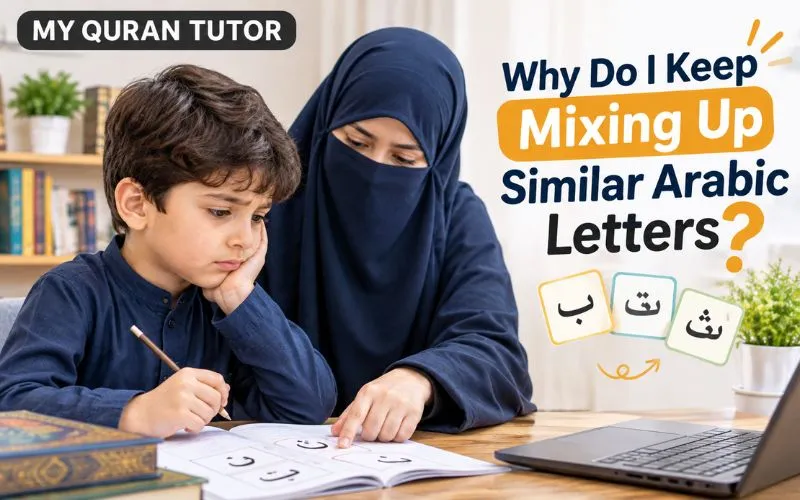
The short answer: You mix up similar Arabic letters because your mouth is quietly swapping them for the nearest English sound, and your ear can’t hear the swap. The fix is to stop asking “what does it sound like?” and start asking “where is it made, and is it heavy or light?” Learn that for six or seven troublesome pairs, practise them slowly side by side, and get a teacher to listen once. Most of the confusion goes within a few weeks.
If you’ve been told “just practise more” and it hasn’t worked, that advice isn’t wrong. It’s just missing a step. Practising a letter you’re saying slightly wrong makes the wrong version stronger. So let’s sort out what’s actually happening first.
Quick Summary
- Letters get confused because English has no direct match for them, so the mouth picks the closest English sound.
- Almost every troublesome pair comes down to two things: where in the mouth the letter starts, and whether it’s heavy (full) or light (thin).
- The seven heavy letters are خ ص ض غ ط ق ظ. Everything else is light by default.
- Swapping some pairs changes the word completely. قَلْب (heart) becomes كَلْب (dog).
- A short daily routine of about ten minutes works better than a long weekly session.
- You can’t judge your own pronunciation reliably. One round of live correction saves months.
Why This Happens (It’s Not You)
Think about what your mouth has been doing since childhood. It has had decades of practice making English sounds. Whenever it meets an Arabic letter it doesn’t recognise, it reaches for the closest English one it already owns.
Take س and ص. English has one “s”. So both letters come out as “s”, and you hear no problem, because to an English-trained ear there isn’t one. The same goes for ت and ط (both become “t”), ق and ك (both become “k”), and ح and ه (both become “h”).
It’s a bit like a person who has only ever eaten supermarket cheddar being asked to taste the difference between two aged cheeses. The difference is real. The palate just hasn’t been trained to notice it yet.
This isn’t a flaw in you, and it isn’t about being “bad at Arabic”. It happens to nearly every English-speaking learner, children and adults alike. We see it in the first lesson with almost everyone.
The Two Questions That Solve Most of It
Forget trying to memorise how each letter sounds. Ask these two questions instead:
- Where does it start? Every letter has a home in the throat, tongue, lips or nose. We cover all seventeen in our guide to Makharij and why where a letter comes from matters.
- Is it heavy or light? Seven letters are “heavy”: the back of the tongue lifts towards the roof of the mouth and the sound comes out fuller and rounder. Those seven are خ ص ض غ ط ق ظ. All the others are light, with the tongue lying flatter.
Four of the seven (ص ض ط ظ) are the heaviest, because the middle of the tongue also rises to meet the roof of the mouth. The other three (خ غ ق) lift the back of the tongue but don’t close off the airflow in the same way.
Almost every confusing pair you’ll meet is either “same place, different weight” or “different place, same weight”. Once you can say which one a pair is, you know exactly what to fix.
The Pairs That Cause the Most Trouble
Here they all are in one table, then we’ll take them one by one.
| Pair | What’s different | Where it matters |
|---|---|---|
| ق and ك | Place: ق is made further back in the mouth | قَلْب (heart) and كَلْب (dog) |
| س and ص | Weight: ص is heavy, س is light | سَدّ (barrier) and صَدّ (turning away) |
| ت and ط | Weight: ط is heavy, ت is light | تِين (fig) and طِين (clay) |
| ذ and ظ | Weight: ظ is heavy, ذ is light | ظَلَمُوا (they wronged), which turns into a non-word with ذ |
| ح and ه | Place: ح from the middle of the throat, ه from the deepest part | الحَمْد (praise) |
| ع and ء | Place and feel: ع from the middle of the throat, ء from the deepest | عَلِيم (knowing) and أَلِيم (painful) |
ق and ك
The difference: place. Both are made with the back of the tongue, but ق starts from the very back, where the tongue meets the deepest part of the roof of the mouth. ك starts a little further forward. ق is also a heavy letter. ك is light.
Why it matters: قَلْب means heart. كَلْب means dog. You’ll find both in the Quran, and the difference isn’t small. The command قُلْ (“say”) is another good one. With a ك it becomes كُلْ, which means “eat”.
What most learners do: say both as an English “k”. The ق ends up too far forward and too thin.
A drill: say قَ, then كَ, slowly, and feel where the back of your tongue touches. For ق it should feel deeper and heavier, almost like the sound is coming from further down. Alternate ten times, then reverse the order.
س and ص
The difference: weight. Both come from the front of the tongue, near the upper teeth. س is light and thin, like a hiss. ص is heavy: the back of the tongue lifts, the sound goes fuller, and the whole letter feels like it fills your mouth.
Why it matters: سَدّ (a barrier, like the one built in Surah Al-Kahf) and صَدّ (to turn away or hinder) are different words entirely. And the very word الصِّرَاطَ in Surah Al-Fatiha, which Muslims say in every unit of prayer, has a heavy ص.
What most learners do: say ص like س. It comes out light and thin.
A drill: say سَ then صَ with the same vowel. For ص, feel the back of your tongue rise. Then try the same with a kasrah: سِ then صِ. The heaviness of ص should stay even with the lighter vowel. Many people lose it there.
ت and ط
The difference: weight again. Both use the tip of the tongue at the same spot behind the upper teeth. ت is light and crisp. ط is heavy, pressed firmer and fuller, and it gets a small echo when it carries no vowel.
Why it matters: تِين is the fig, the word that opens Surah At-Tin. طِين is clay, which appears in several places in the Quran. Said wrongly, the first becomes the second.
What most learners do: say ط like an ordinary English “t”.
A drill: alternate تَ and طَ. For ط, feel the sides and back of the tongue rise towards the roof. The sound should feel deeper and rounder, not just louder.
ذ and ظ
The difference: weight. Both are made with the tip of the tongue at the edge of the upper teeth. ذ is the sound at the start of the English word “this”. ظ is its heavy sibling.
Why it matters: ظَلَمُوا (they wronged) is one of the commonest words in the Quran. Pronounce the first letter as ذ and it’s no longer the same word.
What most learners do: since English already has the “th” in “this”, ذ is easy. ظ is the problem, because it gets said as ذ with no extra weight.
A drill: say ذَ and then ظَ. Keep the tongue position the same, but lift the back of the tongue for ظ. The sound should darken noticeably.
ح and ه
The difference: place. Both are throat letters, but they’re not in the same part of the throat. ح comes from the middle of the throat, with a tight, breathy squeeze. ه comes from the deepest part, and it’s the soft breath you’d use to fog up a pair of glasses.
Why it matters: the very first word of Surah Al-Fatiha after Bismillah, الحَمْد (praise), starts with ح. Say it with ه and you’ve said something else.
What most learners do: say ح like an English “h”. It comes out too soft and too far forward.
A drill: pretend you’re clearing mist from a window, but narrow the throat slightly as you breathe out. That’s closer to ح. For ه, just let the air go without any squeeze.
ع and ء
The difference: place and feel. Both are throat letters. ع is made from the middle of the throat, with the voice on, and no English letter matches it. ء (hamzah) is a short, sharp stop from the deepest part of the throat, like the tiny break in the middle of “uh-oh”.
Why it matters: عَلِيم means “all-knowing”, and أَلِيم means “painful”. Both appear in the Quran, and if you can’t hear the throat letter, the two words blur into one.
What most learners do: say ع as a plain vowel or as ء. It loses its sound and just disappears.
A drill: say “ah” gently, then tighten the throat slightly while keeping the voice on. That squeeze is the beginning of ع. Don’t force it. Most people need several weeks of practice with a teacher before it settles.
Why Practising Alone Can Make It Worse
This is the point most people don’t want to hear.
When you practise a letter alone, you’re using your own ear to decide whether you got it right. But your ear is the very thing that can’t tell the difference. So you repeat the sound you think is correct, and the mistake gets deeper.
It’s like trying to correct your own accent by listening to yourself. You can notice big problems. The small ones slip past, every time.
That’s also why a gentle correction in the first lesson often feels like a small miracle. A teacher can hear the gap in a second, show you what to change, and have you try again until you can feel the difference yourself. We talk more about why in our post on why reading is not the same as reciting.
A Ten-Minute Daily Routine That Works
You don’t need an hour. You need ten minutes, done most days. Here’s a routine our students find easy to keep up:
- Two minutes, warm up. Say the letters of one pair on their own, slowly, with a fatha. Don’t rush.
- Four minutes, side by side. Alternate the pair back and forth: قَ كَ قَ كَ. Then switch vowels. Slow beats fast every time.
- Two minutes, in a word. Say two or three real words from the Quran that use each letter, such as قَلْب and كَلْب, or تِين and طِين.
- Two minutes, record yourself. Play it back. If you can, compare it with a recording of your teacher or a trusted reciter. Don’t judge yourself. Just notice what’s different.
Work on one pair per week. By the end of six or seven weeks you’ll have covered all the ones in this article.
Signs You’re Making Progress
It won’t feel like a lightning bolt. It feels more like this:
- You start to hear the difference when someone else reads.
- You catch yourself mid-word and correct it.
- A heavy letter begins to feel like it fills your mouth, and a light one feels thin.
- Your teacher stops correcting the same pair every lesson.
That last one is the real test.
A Quick Self-Check
Without looking at the table above, can you say which weight or place each of these needs?
- The first letter in الصِّرَاطَ
- The first letter in قُلْ
- The first letter in طِين
- The first letter in الحَمْد
Answers: 1) heavy ص, 2) deep ق from the back of the tongue, 3) heavy ط, 4) ح from the middle of the throat.
If you got three or four, you already have the map. The next step is the sound.
How This Is Fixed in Lessons
In a lesson, the teacher listens first. You read something familiar, and they note which pairs you’re blurring. Then they work through them one at a time, using the same side-by-side method, with live correction until you can hear and feel the difference yourself.
It’s the first thing we do in our Quran reading course with Tajweed, and it’s why the rest of Tajweed makes sense afterwards. If you’re helping a child at home, our piece on the common Noorani Qaida mistakes parents make covers the early signs to watch for. And if you want the bigger picture of where this sits, our beginner’s guide to the rules of Tajweed shows the order to learn things in.
We teach children and adults one-to-one, and you can look at our online Quran classes for kids or check the fees before you book anything.
Want a Teacher to Listen to Your Letters?
Read with someone who tells you exactly which pairs to fix, and corrects as you go. No card required.
Book a Free TrialFrequently Asked Questions
Why do I keep mixing up similar Arabic letters?
Most English speakers have no direct equivalent for several Arabic letters, so the mouth swaps in the nearest English sound without the learner noticing. The fix is to learn each letter’s place of origin and whether it’s heavy or light, then practise pairs side by side with someone listening.
What’s the difference between ق and ك?
Both are made with the back of the tongue, but ق starts further back, near the deepest part of the roof of the mouth, and it’s a heavy letter. ك starts further forward and is light. Swapping them can change the word, as in قَلْب (heart) and كَلْب (dog).
What’s the difference between س and ص?
س is a light letter made with a thin hiss from the front of the tongue. ص is made in the same area but it’s heavy, with the back of the tongue lifted so the sound is fuller. The word الصِّرَاطَ in Surah Al-Fatiha has the heavy ص.
Which Arabic letters are heavy?
Seven letters: خ ص ض غ ط ق ظ. All other letters are light by default, apart from a few, such as ر and the lam in the word Allah, which change depending on their surroundings.
How long does it take to stop confusing these letters?
It depends on your starting point and how often you have lessons, but many learners notice a clear improvement within a few weeks of focused practice with live correction. Letters like ع can take longer.
Can I fix this on my own with videos or apps?
You can learn the theory that way, but you can’t reliably hear your own mistakes. Most people need a teacher to listen at least once, so they know what to aim for and can practise the right sound.
Is this the same problem children and adults have?
Yes. Children and adults both swap letters for the nearest English sounds. Adults sometimes find it harder to retrain the mouth, but they can usually understand the differences more quickly.