The short answer: Tajweed looks like a mountain of rules, but for a beginner it comes down to six families: where letters come from, how letters feel, what happens to a silent noon or meem, how long to hold a sound, the “echo” letters, and where to stop. Learn them one family at a time, in that order, and most of the fear goes.
If you’ve ever opened a Tajweed chart, seen twenty colours and thirty Arabic terms and quietly closed it again, this guide is for you. You haven’t failed at anything. Those charts are made for people who already know what they’re looking at.
Let’s start from the other end.
Quick summary
- Tajweed means giving each letter its due when you recite. It’s a skill, not a pile of facts.
- For a beginner, the rules fall into six families. You don’t need all of them at once.
- A sensible order: letter sounds first, then letter qualities, then noon and meem rules, then Madd, then Qalqalah, then stopping.
- Some rules can wait. Deeper Madd types, rare Idgham cases and fine points of heavy and light letters are for later.
- Learning the rule is the easy half. Hearing yourself get it right is the hard half, and that’s what a teacher is for.
So What Is Tajweed, in Plain Words?
Tajweed comes from an Arabic word meaning to make something better. When we use it for the Quran, we mean reciting each letter properly: from the right place, with the right quality, for the right length, in the right order.
The best way to think about it is as a set of habits, not a set of facts. A footballer doesn’t learn “rules” for kicking a ball. They learn habits until the right thing happens without thinking. Tajweed works the same way. The rules are how we describe the habits so they can be taught.
That’s why it feels so heavy when you try to learn it from a chart. Charts describe. They don’t train.
The Six Families of Tajweed Rules
Here’s the map. Keep it somewhere handy, because the rest of this guide is just walking through it.
Let’s take them one at a time.
1. Makharij: Where Letters Come From
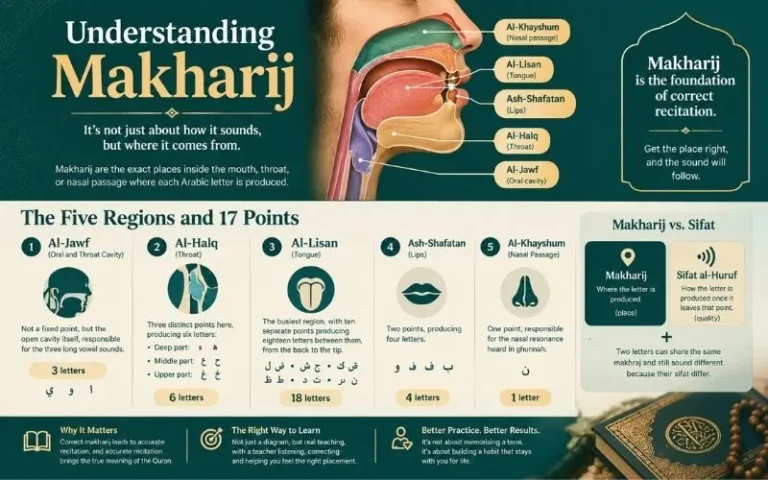
Every Arabic letter has a home inside the mouth, throat, lips or nose. Tajweed teachers call those homes makharij. Scholars traditionally count seventeen of them, grouped into five regions.
This is first for a reason. If a letter starts in the wrong place, every rule built on top of it is built on sand. We’ve written a full explainer on Makharij and why where a letter comes from matters, so we won’t repeat it here. The short version: you can’t hear this one on your own, which makes it the best argument for having a teacher at the start.
2. Sifat: How Letters Feel
If Makharij is where a letter lives, Sifat is its personality. Some letters are heavy and full in the mouth. Some are light and thin. Some are released with a push of air, some held back.
The easiest example is a heavy letter next to its light cousin. ص (saad) is heavy and fills the mouth. س (seen) is light and sits near the front. They share a lot, but if you swap them, you’ve changed the word.
For a beginner, you don’t need every quality. Start with the seven letters that are always heavy (خ ص ض غ ط ق ظ) and the idea that the rest are, by default, light. A couple of letters, like ر (ra) and the lam in the word Allah, change depending on what’s around them. Those can wait.
3. Noon and Meem Rules: What Happens to a Silent Letter
This is where most beginners first feel lost, and it’s actually one of the most logical parts of Tajweed.
A noon with no vowel (or the “n” sound at the end of a word like kitabun) behaves differently depending on the letter that comes after it. There are four possibilities:
- Izhar (clear): the noon is pronounced clearly. This happens before six throat letters (ء ه ع ح غ خ).
- Idgham (merging): the noon blends into the next letter. This happens before six letters (ي ر م ل و ن).
- Iqlab (flipping): the noon turns into an “m” sound before the letter ب.
- Ikhfa (hiding): the noon is half-hidden, with a soft nasal sound, before the remaining fifteen letters.
Six, six, one and fifteen. That adds up to the whole alphabet, which is why the system feels tidy once you see it.
The silent meem has an even smaller set of three rules: before ب it’s hidden, before another م it merges, and before any other letter it’s pronounced clearly.
We’re going to give these their own full guide soon, with real verses. For now, the thing to hold onto is that you’re learning one question: what letter comes next? Everything else follows from the answer.
4. Madd: How Long to Hold a Sound
Madd means stretching a vowel. It sounds simple, and in a way it is. The difficulty is that different situations need different lengths.
The most common one is the natural stretch, which you meet whenever a long vowel (alif, waw or ya) isn’t followed by anything that changes it. You hold it for two counts. A “count” is roughly one steady beat, about as long as it takes to say a short word at a relaxed pace.
Other types stretch longer, to four, five or six counts, depending on what follows the long vowel. The exact counts differ between the recognised recitations. Most UK students learn the one called Hafs, and the numbers in this guide follow that. Your teacher will tell you if you’re learning a different one.
For a beginner, learn the natural two-count stretch first and get it consistent. The longer types make a lot more sense once the baseline is steady.
5. Qalqalah: The Little Echo
Five letters bounce a little when they have no vowel. They are ق ط ب ج د. Say the dal in yadkhulun, or stop on the qaf at the end of al-falaq, and you’ll hear the tiny echo that follows.
It’s one of the first rules that sounds like Tajweed when you do it right, which is why students enjoy it. It’s also one of the easiest to overdo. A good teacher will teach you to give it a light bounce rather than a whole extra syllable.
6. Waqf: Where to Stop and Start
You can’t read a whole surah in one breath, so you have to stop somewhere. Waqf is the set of rules for where that’s allowed, where it’s discouraged, and where it would change the meaning.
Most copies of the Quran mark these with small symbols above the text. For a beginner, you don’t need to learn every symbol at once. Start with the common ones, and rely on your teacher to tell you when a pause changes what the verse says.
What You Can Safely Leave Until Later
This is the section most guides skip, and the one most beginners need. You do not have to learn the following in your first stretch of study:
- The deeper kinds of Madd (the longer, rarer types).
- Special Idgham cases and exceptions.
- The finer points of when a ر or the lam of Allah is heavy or light.
- The full list of letter qualities.
- Recitation styles other than the one you’re being taught.
Leaving these for later isn’t cutting corners. It’s how the subject is taught. Layer one on top of the next, and it holds.
A Sensible Order to Learn Things
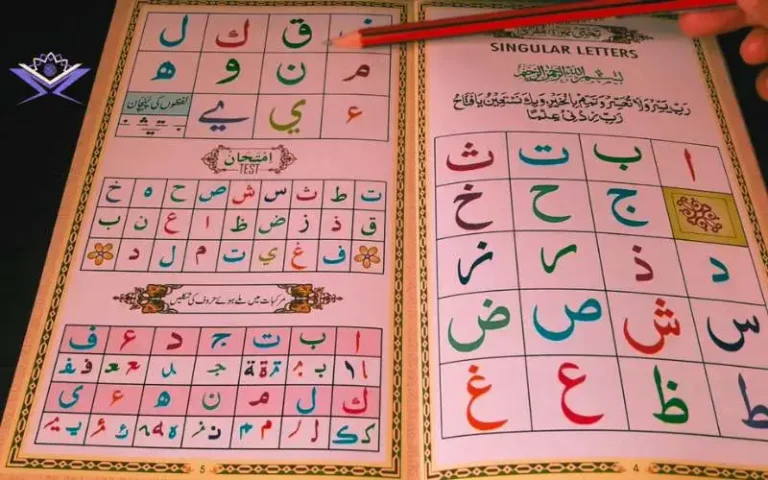
Here’s the order we’d suggest to a complete beginner, assuming you can already read Arabic letters. If you can’t yet, start with Noorani Qaida first.
- Makharij. Get the letters coming from the right places.
- The main heavy and light letters. Just the seven always-heavy ones.
- Noon and meem rules. One rule at a time, practised on short verses.
- Natural Madd. Two counts, consistently.
- Qalqalah. The five echo letters.
- Basic waqf. The common stops, then more later.
- Deeper Madd and the finer rules. Only once the earlier steps are steady.
How long each step takes depends on you: how often you have lessons, how much you practise, and what your starting point is. A rule counts as learned when you can apply it correctly without thinking about it, not when you’ve read about it. Move on when the habit is there.
Why Learning the Rule Isn’t Enough
You can read every rule in this article and still get half of them wrong when you recite. That isn’t a flaw in you. It’s how pronunciation works.
Your ear was trained on the sounds you grew up hearing, so a slightly wrong letter can sound perfectly fine to you. We covered this at length in our piece on the difference between reading the Quran and reciting it properly. The short version is that a rule tells you what to aim for, and a teacher tells you whether you hit it.
It’s also why we’d gently steer you away from learning Tajweed purely from videos and apps. They’re useful for the rules. They can’t hear you.
How Beginners Actually Learn This With Us
In our Quran reading course with Tajweed, the rules are taught in roughly the order above, one at a time, each one practised on real verses before the next is added. The teacher listens first, so your lessons start from where you are, not from the top of a syllabus.
If you’re still working on the alphabet, our Noorani Qaida course is the right place to begin. And if you’re an adult who has been putting it off, you can read our guide to Noorani Qaida for adults.
You can see everything we teach on our homepage, which covers online Quran classes for kids and adults, and you can look at the fees before you book anything.
The One-Minute Version
If you only remember one thing: Tajweed is six habits, learned in order, with someone listening. That’s all it is. Start with where letters come from, and take the rest one family at a time.
Want to Start From Where You Actually Are?
Book a free trial lesson and read with a teacher who listens first. No card required.
Book Your Free Trial Lesson →Frequently Asked Questions
What are the basic rules of Tajweed for beginners?
The basics fall into six families: Makharij (where letters come from), Sifat (how letters feel), the noon and meem rules, Madd (stretching vowels), Qalqalah (the echo on five letters) and Waqf (where to stop). Beginners learn them one family at a time, not all at once.
Which Tajweed rules should I learn first?
Start with Makharij, so letters come from the right places. Then learn the main heavy and light letters, the noon and meem rules, the natural two-count Madd, Qalqalah and basic stopping. Leave deeper Madd types and finer points for later.
How many Tajweed rules are there?
There’s no single agreed number, because scholars group them differently. For a beginner the useful way to count is by families. Six families cover what you need at the start, and each one has a small number of rules inside it.
Is Tajweed hard to learn?
Tajweed is easier than it looks, if you learn it in order and with someone listening. It feels hard when you try to learn everything from a chart at once. Most of the difficulty is in hearing your own mistakes, which is why a teacher helps.
What are the Qalqalah letters?
They are ق ط ب ج د. When one of these has no vowel, it gets a small echo or bounce.
Do I need to know Arabic to learn Tajweed?
You don’t need to understand Arabic, but you do need to be able to read the Arabic letters. If you can’t yet, start with Noorani Qaida and move on to Tajweed after that.
Can adults learn Tajweed from scratch?
Yes. Adults learn Tajweed at every age, often starting from the alphabet. The rules and the order are the same as for children, with lessons paced around your week.